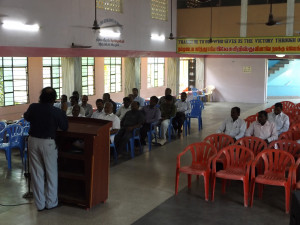
You will also find details of John’s recent sabbatical in Sri Lanka and India where he visited various churches and organisations to see how God’s word is put into action.
]]>
The Messenger, The Message, The Community by Roland Muller, Fourth Edition 2015
The 3D Gospel, Jayson Georges, 2014
Essentially human civilisation is divided into three main ways in which people tend to view the gospel:
- Guilt-Innocence = particularly in the Western world people have a highly individualistic sense of self. Life decisions will be made on the basis of right and wrong -> leading to a strong sense of personal guilt when the person does the ‘wrong’ thing.
- Shame-Honour = e.g. in Hindu, Buddhist and Islamic cultures there is a far stronger sense of community. Therefore decisions are made on the basis of building or protecting honour to the family/community or avoiding shame. Hence I act according to how others would think about me.
- Fear-Power = especially in animist cultures decisions are made to placate powers that cause fear. In religious terms that may mean seeking help from a witchdoctor to heal a snake bite or sacrificing a bull to appease spiritual forces so that it will rain.
I have found this framework very helpful. All cultures involve all three worldviews but will tend to emphasise one or the other. So, in the UK, we tend to explain the gospel in terms of Jesus taking away personal guilt. In India or Sri Lanka, people like to hear that Jesus has removed corporate shame and how the gospel impacts on family and wider communities. Similarly in rural India or Africa people live in terror because of demonic powers. As always with tools like this the danger is that the tool takes over (for a man with a hammer everything looks like a nail!) and that we end up with three gospels – one each for Western, Eastern, and Tribal cultures. Nevertheless, as long as we remember that everybody needs to hear the whole gospel, this is a useful tool.
As London (and the UK) becomes more multi-cultural it is important that we show how the gospel applies to all three of these worldviews. It is not a case of one being ‘more right’ or ‘better’ than the other – they are all Biblical. Rather we need to point out that different Bible passages speak into all three frameworks in different ways.


Across Sri Lanka, North and South India, I got pretty much the same answer. The mainline churches were characterised by weak and ineffective leadership – usually bound by tradition, no growth, ruled by committees. India, especially, is still a very religious country. Therefore, while most Indians would call themselves Hindu (rather than Christians) they would still see religion as central to everyday life. Marriage is a classic example. Very few people would consider a secular wedding. Religion is still perceived as the gatekeeper for social institutions like marriage. Hence I frequently heard Christians say that the main big plus that keeps the mainstream denominations going is that they are officially recognised by the state for things like weddings and funerals.
So, overall, the traditional churches are seen as existing to maintain the tradition. They present the institution that is to be preserved. Many Pastors view their role as preserving this power and so are mostly interested in money and status. On the rare occasions when a gospel hearted Pastor seeks to motivate his church for evangelism he is usually squashed by powerful committees that want to keep the status quo.
This view leads many evangelicals to attend two churches. They go to an independent church to grow as disciples but they keep their membership at the traditional church in which they grew up for weddings, funerals, schooling etc.
In contrast the independent churches are mostly growing. They tend to be Pentecostal in style with very strong leadership. The Pastor is not hampered by lots of committees but is given freedom to cast vision and give a clear direction.
It is not all good news though. Along with the strong leadership often comes overbearing authoritarian leadership (due to lack of accountability) and frequent church splits.
In the UK I don’t think that the contrast is quite as stark but the issues are the same. Therefore, while it will not look the same in the UK, we do need to think through these issues. As a generalisation Christians from the global south (e.g. India, Africa, South America – where the church is growing rapidly) are more used to strong church leadership. They are not accustomed to democracy in church, rather they expect their church leaders to make decisions and then get on with it. Consultation, yes; but democratic consensus, no.
Now, that does not mean that British churches must change their structures entirely to adapt to the expectations of 1st generation immigrants. In reality we need to come up with structures that are appropriate for our multi-cultural British context. Nevertheless, these trends still apply; and, interestingly, social changes in Britain are having a similar impact here. As we get busier and busier so white Brits too no longer expect to be involved in the minutiae of church decisions. I notice a trend that those under 50 don’t have the spare mental capacity to engage with the day-to-day running of the church. Therefore the 21st century church will need to give their leaders less bureaucracy and more delegated authority. (Mind you, with ever increasing red-tape coming out of Whitehall there will still be plenty of bureaucracy to deal with, it is just that we must stop this from clogging up our pastoral ministry.)
Christians have argued for centuries over how best to translate the Greek word ‘episkope’ in 1 Timothy 3 – Roman Catholics and Anglicans would render it ‘Bishop’ whereas Baptists would prefer ‘overseer’. Overseer gives the more literal meaning of the word but, of course, the debate is whether Paul is using it to describe a specific role of oversight or just an overseer in general. Likewise, was this overseer overseeing a church or lots of churches? Does it matter?
In short, I don’t think the NT gives us a clearly defined blueprint for church leadership for all time. Context will probably shape appropriate forms. However, there are Biblical principles that we should bear in mind. Passages like 1 Peter 5: 1-4 seem to use the three NT terms of ‘elders’, ‘overseers’, and ‘pastors’ interchangeably. Likewise Acts 20 seems to describe plural leadership within the early church. I’m not so bothered exactly what you call them but healthy, growing churches need strong leadership, yet leadership that is transparently accountable.
Spending time in Sri Lanka and India has helped me to see this more clearly. With time, mainline churches tend to fossilise. Institutionalisation happens when committees etc. are set up whose main aim is maintaining the organisation. Baptist churches must be careful to make sure that Deacons’ meetings and Church Members’ Meetings don’t exist solely as the brakes for the Pastor/Staff team’s leadership.
Equally when the Pastor is perceived to be the sole leader, Baptist churches can fail in keeping him accountable. Then meetings become mere rubber-stamping exercises. Instead we need structures where leaders are encouraged to lead but that authority is not localised in one person. Ideally both paid-staff and volunteers need to share the leadership – for various reasons: 1. It breaks down the ‘them & us’ of the staff team. 2. It earths leadership within the local church community – staff come and go, but many church members see several Pastors out.
Therefore churches need Leadership Teams – i.e. A group of equal leaders. Decisions need to be made collectively but the group should consist of leaders and not those who view themselves as primarily representing the needs of the church. As the word ‘overseer’ implies, these leaders have the main focus of pastoral oversight of the church.
Now, let’s face it, this is raising the bar of church leadership. It would mean having a team of ‘pastors’, most of whom are ‘just’ normal church members. Clearly it is unrealistic to expect volunteers to take on most of the role of a Pastor – I doubt if it was ever possible but now we are all too busy. However, I’m not talking about the job so much as the responsibility. Although such a role would inevitably demand time, this is not about doing lots of things within the church but about giving a lead; taking responsibility for decisions.
Again and again I was told (especially in India) that leadership is the desperate need of the church. There is a saying in Tamil, “So as the king …”, which means that leaders set the tone and character of those whom they lead. If this applies to the UK too then we must be focussing on this as a church. Even more important than systems is a culture of godly leadership. We need to know what NT leadership looks like and we must actively raise up and train leaders within RLBC. And then we should reform our structures so that they intentionally facilitate that kind of leadership.

For centuries England has been a Christian nation. By that I mean that our Kings & Queens have been Christians, the state church has been Christian and our government has privileged the Christian religion. Whether England ever was a truly Christian nation (beyond mere nominalism) is doubtful, but it certainly isn’t anymore.
Therefore it was interesting to feel what it is like to live as a Christian in a non-Christian country. There are strong nationalistic drives to equate being Indian with being Hindu and similarly being Buddhist is seen to be synonymous with being Sri Lankan, well Sinhala really. So I took careful note and asked many questions about what it is like to live as a Christian minority within such environments. Both countries claim freedom of religious expression but there are many ways that society and government can marginalise minorities if they so choose.
There is so much we can learn from these South Asian Christians who have been living under these conditions for many years. Here in the UK we take the privileged status of the church for granted. Such political power is fading fast, if it hasn’t gone already. We must stop bleating and whining about privileges that are being removed from us (which other religions never had in the first place) and learn to live as a faithful minority within a pluralistic society.
What I saw in India and Sri Lanka was a very healthy view of society and human government. There was respect and support. For example I took part in a Christian celebration of Independence Day in India. These Christians were very proud of their country and keen to live as responsible citizens with their nation. However, they were not impressed by political power, nor afraid of it. In Hikkaduwa the church was rather phlegmatic about future attacks – ‘if they set our church on fire again, let them, we will carry on the same, regardless.’
Three Biblical passages are worth reflecting upon:
1. Romans 13: 1-7
Human governments are a gift from God to society. They restrain evil and Christians should seek to be responsible citizens, paying their taxes even. Therefore churches should adopt the same attitude. The local council is for our good, we should want to support them in managing our borough well. Christians do not withdraw from society, we get stuck in!
2. John 3: 16 (John’s gospel in general)
The word translated ‘world’ in John’s gospel does not refer to the physical planet on which we all live. Instead it is the summation of human society and civilisation which is opposed to God. It is impossible to read John’s gospel without realising both how much God loves the world, but also that the default position of the world is against God. Therefore a truly Christian view of society is that it needs redeeming by Jesus. If all Christians do is make society better and more efficient, then we merely succeed in making it better at rejecting God.
3. Revelation 13: 1-10
In John’s apocalyptic vision he views human government as seeking to usurp God as the rightful ruler of the world. Sometimes, as I saw in Sri Lanka and India, human opposition to God overflows into the direct persecution of God’s people. When that happens Christians are called to stand up against the evil state but to do so without violence. “If anyone is to go into captivity, into captivity they will go. If anyone is to be killed with the sword, with the sword they will be killed.” Currently the press is full of articles trying to understand the worldview that produces terrorists for Islamic State. Most conclude that the problem happens when people become alienated from society. However, Christians are also called to be citizens of heaven – we too do not feel at home in this world. BUT the huge difference is that Jesus calls us to non-violent means. We do not force anyone to accept our worldview, rather we accept that holding to our beliefs may mean our captivity or worse.
Putting those three passages together we need to rethink our identity as Christians in London today. While there are obviously aspects to the analogy that I want to avoid I like the famous slogan of Millwall FC from the 1970s – “No one likes us. We don’t care.” I reject the violence that led to that image in the first place. (Mostly no one liked them because they were hooligans.) But I do like the strong sense of a minority identity that they created. If I can stretch the analogy – Millwall were happy to remain full citizens within the English FA league, but they were secure enough in their identity that they didn’t care if they were popular or not. Far too many Christians are concerned about being ‘respectable’. The irony is that the first Baptists left the state church because they saw how corrupt being ‘respectable’ can be; they were dissenters precisely because they chose Christ over respectability.
We need to grow that sense of identity as Christians in the 21st century. We want to bless our society and so we get involved. But if people mis-read our motives or marginalise us we are “not bovvered!” We just get on with it. I support the work of the Christian Institute and others who campaign on behalf of Christian influence in the UK. In a democratic society Christians have just as much right as anyone to put forward their views. However, we do this with gentleness and respect. There is far too much whinging and special pleading by Christians today. Outraged that we are being treated like everyone else. Once more this is about attitude most of all. For example, if local schools ever try to force Karen out of ‘Christian’ assemblies we will certainly protest and plead our case. But we ask, we do not bully. We request from a position of weakness, not one of power. We are secure in our identity in Christ and that does not change depending on how popular we are in the eyes of society.
In the words of the much underrated philosophers of the last century, Mel & Kim, “Like us, hate us, but you’ll never change us, we ain’t never gonna be respectable!”
If you feel unable to really put your heart into Millwall as a metaphor then maybe Mahatma Gandhi’s advocacy for non-violent civil disobedience is something you might relate to more easily. I suspect that it will become increasingly useful to Christians in the UK.
(BTW That is Lopez in front of Gandhi’s statue on Marina Beech, Chennai.)


This has made me wonder in what ways we are ‘good news’ in Rayners Lane and Harrow? The Holiday Bible Club generates lots of good will, plus Food Bank collections and the council’s use of our premises all count too. However, I’m sure that those things are just scratching the surface. We need to do some research into what are the greatest needs of our community and how best we can share the love of Christ locally.
This is not just about evangelism. All of the ministries I saw overseas were primarily about helping people. (They were happy to share the gospel but there were no strings attached or hidden agenda to the work they were doing.)
This comes down to the relationship between evangelism and social action. The UK church has been arguing over this for about 100 years. Generally speaking, traditionalists are wary of social action because they feel (with some justification) that it tends to lose a grip on the gospel. And progressives are supportive of social action because they think (with some justification) that just preaching at people has no relational context and is not loving.
So, where do we go from here? Is there a way out of this impass? To start with we must always keep the gospel the main thing. The gospel is central to everything we do. It is not the way into the Christian life only, it is the Christian life. The gospel is not just something we tell people so that they become a Christian, and then go on to other things. Rather the gospel shapes how we behave as well as what we believe.
Let me use an analogy. When my daughters were little they both got chicken pox. (I had to drive around the Lake District in the pitch black at night to get Sophie to sleep, but that is another story.) While their bodies were fighting the virus we did all we could to relieve their discomfort. Camomile baths, you know the sort of thing. Now, we knew we were not treating the virus. All we were doing was helping with the symptoms, but we did it because we loved them. A loving parent keeps treating the symptoms until the disease is fully cured.
So it is with any social project. If we love our neighbours we will want to help treat the symptoms of sin in our fallen world. And we will be happy to do so regardless of whether they become Christians or not. However, we will always want to point them to the only cure for their condition and we will never kid ourselves that we are doing anything more than giving temporary relief of their symptoms.
Therefore attitude and motivation is essential. There is nothing wrong with churches getting involved in ‘purely’ social action projects. But only if we always keep in mind why we are doing it and what we are achieving. The moment we start thinking that treating their symptoms is the main game then we have lost the gospel.
Let me give some practical illustrations of how this happens. When any social action loses it’s clear gospel motivation then look out for the following things …
1. Pride – a tell-tale sign that things are going wrong is when people start talking about all the ‘good I am doing’. ‘Wow, we are really making a difference in people’s lives.’ Notice it is not God and his gospel changing people, it is me. One representative from a parachurch organisation told me that their aim was ‘not to preach the gospel, but to be the gospel.’ I think (I hope!) I know what he meant – i.e. They do not preach to people but only share the gospel if those they work with ask. However, the phrase itself is deeply troubling. The Greek word for ‘gospel’ means ‘a proclamation of good news’. Like a town crier shouting out a famous victory that ends a war. If I ‘am’ the gospel then what I’m saying is that the help I’m giving this programme is much better news than anything Jesus did 2000 years ago. Again, I’m sure the phrase is not meant that way, but that is what it means. Who is making the world a better place? Is it me or is it Jesus? In Matthew 5 Jesus tells us to be salt and light. He expects people to see our good deeds, but to praise our Father in heaven as a result. Who gets the glory for our good deeds?
2. Self-righteousness – linked to pride in our own abilities and resources to help people comes a pharisaical spirit. What I’ve noticed is that when we lose our confidence in the gospel we forget that we are all sinners saved by grace. Then we start to look down on people who are not helping in our ministry. ‘Don’t you care about the poor? You can’t really be committed to Christ if you don’t volunteer at the food bank!’ A few years ago research showed that people who are environmentally conscious are often willing to trade that ‘goodness’ off with other areas in their lives. E.g. ‘I’m really good at recycling and so it doesn’t matter if I steal or lie a bit.’ Deep down we are all little legalists who think we can save ourselves. Social action programmes can encourage us to think that we are much better than everyone else.
3. Frustration – as soon as we forget that we are dealing with symptoms and that only Jesus can deal with the root cause we will get frustrated. ‘The poor you will always have with you.’ There will always be more poor people to help, more sick people to heal, more depressed people to comfort. If we seek to tackle the problems of the world in our own strength then we will quickly be overwhelmed. When serving becomes a chore it probably means that you’ve lost your gospel motivation.
Therefore it is all about vision and leadership. Let’s get more involved in helping our local community but make sure that the vision for every project is always gospel focussed. Once more, that does not mean that everything has to be explicit evangelism but it is more to do the motivation and bigger picture of those involved. And for that vision to be maintained we need leaders who buy into that vision and keep it always before their team.
I think RLBC needs more community engagement, but ministries staffed by church members who are so committed to Jesus that they can’t help sharing about him when they volunteer. A church full of people who love their neighbours so much that they want to tell them about the cure as they help them with the symptoms. This was what I loved about Sri Lanka and India. They were not ‘preaching’ at those who came to them, and yet there were frequent opportunities to talk about Christ. My prayer is that becomes the same at RLBC.

Generally speaking there is a simple (again, not naive) faith in God and in the gospel of Jesus Christ. They expect the Lord to answer prayer. They expect Him to intervene (even miraculously) in present circumstances. It is assumed that the gospel will make a difference to our lives – because otherwise it wouldn’t be true, would it?
Sadly I seldom experience such expectancy back home – myself included. It reminds of this story told by C.H. Spurgeon: You may have heard the story of one of our first students, who came to me, and said, “I have been preaching now for some months, and I do not think I have had a single conversion.” I said to him, “And do you expect that the Lord is going to bless you and save souls every time you open your mouth?” “No, sir,” he replied. “Well, then,” I said, “that is why you do not get souls saved. If you had believed, the Lord would have given the blessing.” *
I do not tell that story to lay a guilt trip on preachers who see little or few conversions. If we trust in the sovereign work of the Holy Spirit then faithful preachers may see few conversions. But faithful preachers will still carry on expecting God to save some through the gospel.
When I preached through the book of Malachi I gave the series the overall title of ‘Practical Atheism’. When I first thought of the title Michael Hews disagreed – ‘but atheism is not very practical,’ he said. However, that was not what I had in mind. Malachi addresses practical atheism in the sense that the Israelites claimed to believe in the Lord but were atheists in practice; their lives revealed what they really believed.
I think that could be said of much of western Christianity. We have wearied the Lord by saying that those who do evil are actually good. We excuse sin because we do not expect the gospel really to change lives. We excuse the lack of church growth because we do not expect God’s word to speak to the lost. We excuse our reluctance to pray for healing or to cast our demons because we do not really expect God to work that way, at least, not anymore.
My prayer is that the UK church will get infected by the vibrancy of the church from the global south. I’d love to see the levels of expectancy that I witnessed in Sri Lanka and India occur over here too.
In our church services, in our Bible study groups, in our daily lives – a high level of expectancy for God to work in power.
There are two provisos though:
1. The danger of an over-realised eschatology. That is just the expression theologians use to describe people who think that we are already in heaven now. That is to say, they expect all the blessings promised for paradise now, immediately, in the present. For example, when Jesus rose Lazarus from the dead it was qualitatively different from his own resurrection. Lazarus was resuscitated rather than resurrected – he came to life, only to die again. However, the resurrection bodies that we will have in the new heaven and earth will be like Jesus’ body – they will be immortal. This is important when we think about expectancy in prayer. When I pray for healing, I do so realising that that full healing will only ever happen when Jesus returns. Likewise I wrestle with sin all my life and expect victory, but also know that sinlessness will only happen in heaven. And so on… We do expect God to work but we do not expect all kingdom blessings right here and now. The way of the cross promises suffering on the route to resurrection. It has been said that conservatives ignore the life and ministry of Jesus – they act as if the gospel only involves the death of Jesus. If that stereotype holds at all then the reverse if also true – Pentecostals often act as if the death of Jesus was an embarrassment to be quickly glossed over.
2. South Asian Christians are not perfect either. One of the biggest problems in churches out there is the moral failure of Pastors. They often excuse sin as well, because they don’t really expect the gospel to change lives.
*Spurgeon, C. H. (1895). The Soul Winner: How to Lead Sinners to the Saviour (52–53).

September 3rd – Forever England
]]>And so our culture almost always places ability way above character. The chat I had with the Registrar in Chennai mostly revolved around this issue. I can see how difficult it is to focus on character in a college – how do you do an exam or essay on character? Where is the pass / fail boundary? But being difficult to assess is no excuse for ignoring it. According to the Scriptures it is the MAIN thing. Here, especially, churches take just as much blame as Bible colleges. This is a problem that runs right through the culture today. When churches interview they always look for gifting first. I was on the ‘phone to a friend today who was seeking help in tracking down some references. I was able to point him to people who could provide that for him. As we chatted on the ‘phone he admitted mistakes from the past when references have been ignored or over-looked. But if character is the most important thing then surely this should be key to the selection process, not a mere after thought?
I remember one interview where a candidate got a little upset when I asked a personal question about his marriage. It is quite possible that I could have asked it more sensitively. But it was only one question after lots of others. If Paul says that the way we tell if someone is suitable for church leadership is by looking at their marriage and parenting then why is it rude to ask one question about it?
Again and again this came up in India. Character is not addressed during training and once out of college there is no structural mechanism to watch and develop the character of church leaders. What is the point of knowing Greek and Hebrew if the heart is not serving the Lord? (Now do you see why this post came after the last one?)
It is common for church conferences to refer to the crisis of leadership within the evangelical church. That is true, but it is not always recognised that leadership is primarily (not only, but primarily) about character. Knowing the right thing to do requires biblical wisdom. In my experience that is hard, but nowhere near as hard as having the character to do the right thing… And both pale in to insignificance compared to having the character to lead a whole church to do the right thing!
I was really encouraged by some of the training initiatives I saw in India. Pastor Joshua’s Timothy Training Initiative is exactly what is needed. Personal accountability and 1-2-1 mentoring as well as teaching information and skills. These kind of initiatives need to be simply expected as normal both in colleges and in churches.
What I loved about some of the Pentecostal ministry I saw in Sri Lanka and India is that it expects the gospel to ‘work’. If the gospel is true then it should make a difference to my life. And why should I believe someone about the gospel if it doesn’t make a difference to their life? The same attitude applies to healing and demonic forces. I witnessed a simple (not naive) willingness to take God at his Word. I would make a terrible hair-restorer salesman (because I’ve not got much hair … On the top of my head at least). So similarly is it really surprising that most British people do not want to follow Church leaders when the gospel seems to make so little difference to our lives?
After my last post some might be wondering how it is possible to focus on character AND provide in-depth academic training. Won’t colleges need to drop courses on homiletics and systematic theology? In short, no. This is not so much about content as culture. Not so much what as how. When we lived in Sydney I was very impressed by the culture the then Principal, David Cook, had created at Sydney Missionary & Bible College (SMBC). All lecturers were expected to preach and be involved in local churches regularly. All staff and students went on a mission trip (around Australia or overseas) every year. I’m sure that some lecturers would hate that – ‘but I’m not gifted to preach!?’ Yes, but you don’t have to be brilliant; and you don’t have to do it a lot. Nevertheless this models that the church is the main game; that the point of studying theology is to apply it to the church. I don’t expect lecturers to have the gifts to make excellent Pastors or Sunday School teachers. We need men and women who do the technical study in order to resource the church. But we must never forget that is why we need theologians. What is the point of any lecture if it is does not train people for gospel ministry? According to the Bible the church is God’s main agent of reconciliation in a needy world. There is no plan B. That does not mean that everyone should work for a church. Christians can serve Christ in the secular work place and in the charity sector etc. But they do so as members of Christ’s body, the church. So many parachurch organisations give the impression (maybe unintentionally) that what they do is really the most important thing, and that the church is really holding them back. Which is a bit like saying that my marriage would be perfect if only my wife got more with the program.
We need to recover the notion of catechism from the early church. Didactic teaching goes hand in hand with 1-2-1 discipleship. And this does not stop once we finish our formal training. Once Christians are appointed to any position of leadership within the church the need for training (in wisdom and character) increases, it does not stop. I have been very grateful for the mentors I have had throughout my ministry. A big thank you to Colin Sedgwick who has been doing that job over the past three years but now he has moved to Nottingham I am looking for a new one.
I have been really convicted about this while I’ve been away. I have no political influence in theological colleges (and so it is easy for me to criticise  ) but I can try to model this in my own church. In the future I want to spend more time focusing on raising up godly leaders. It is the height of hypocrisy to complain about this if I’m not doing all I can to develop this kind of culture.
Later I will make some practical suggestions from what I have learnt while away in Sri Lanka and India…

And it is the need for more academically rigorous theological training. The world is changing and so the method of delivery may well change (e.g. More flexibility – part time, distance learning etc.) but there is a greater need than ever to produce church leaders who have the depth of education necessary to meet the challenges of our day. That will mean that they spend time studying the Bible and meditating on it for themselves, but also that they have the academic skills to think deeply about it too.
Trends within education generally in the UK push the other way. More practical usually means more general. Students don’t see the need for subjects like Greek or Church History (what’s the point?) but prefer more ‘applied’ subjects. People want to be trained to do a job.
This trend will gather momentum in the next few decades. All the books I have read over the summer make the same prediction – the church of the 21st century is going to be increasingly dominated by the global south. For the past 300 years or so western academics and church leaders have set the pace for global church trends. Not anymore. Increasingly the average Christian is not white, but a Brazilian, Nigerian or Philippino. And the church of the global south is generally Pentecostal. Even the Catholic Church in these parts of the world is increasingly Pentecostal. Therefore the church in the UK is going to be heavily influenced by Pentecostalism too.
Now one of the downsides of Pentecostalism is that it often encourages anti-intellectualism. There have been some wonderful exceptions – e.g. Max Turner and Gordon Fee – but as a general trend it does hold water. As we shall see later, I think there are lots of good things we can learn from this trend, but this is one to avoid. Jesus told his followers to love God with all their minds as well as their hearts.
So the trend away from academic theological study is likely to grow. Training for Church leaders will become more practical and less technical and academically stretching. However, I think that trend should be resisted for the following two reasons:
1. Society is changing faster than ever. Any study of history will show that societies often go through periods of great change. The first century AD and the break up of the Roman Empire were also times of great change. I’m not sure if culture has ever changed as quickly as now though. As an example I found preparing for a sermon on ‘Trans Gender’ particularly challenging. Reading around the subject I was bewildered. It really felt as if the world was changing so fast I was finding to hard to keep up, never mind give a lead to my congregation. If this is the case then church leaders need to be educated to a much deeper level. I do not mean that greater sociological study should replace personal study and application of the Scriptures. Rather I am talking about the technical skills required to study the Bible in depth.
2. Society is better informed than ever before. Originally I wrote ‘better educated’ but I have just changed that to ‘informed’. (I’m not sure British education is better but there is certainly more information imparted.) A century ago any Pastor with a theological degree would be far better educated than the vast majority of their congregation. After Tony Blair’s goal for 50% of UK school leavers to go to University that is no longer the case. Any given sermon or church meeting most people sitting in the pews will probably think (to themselves) that they know as much about the topic under consideration than their church leaders. After all they read a Wikipedia article about it. (Again, that does not mean that they really are equally informed, but that the perception remains.) In such a context any Church leader will need to be able to think profoundly in applying the Bible to the modern world in order to speak into people’s lives. Frequently I attend church services or other Christian meetings where I do not get the impression that those at the front have a deeper understanding of the issues than I do – even though they have (supposedly) prepared. Once more, that is not me blowing my own trumpet – it is a reflection on how superficial most theological reflection usually is.
I remember my first day at Bible College, over 20 years ago. I remember because our Principal, Peter Cotterell, gave an address to all new students that has stuck with me. His charge to us was that we had come ‘to understand profoundly in order to explain simply.’ He went on to outline the dangers of understanding profoundly in order to explain profoundly or understanding simply in order to explain simply. The latter is my common experience.
Let me take an example. Technical subjects like Biblical languages or Church History are not in vogue. Yet any discussion of homosexuality over the past 20 years has included looking at the definition of the Greek word ‘arsenokoites’. I freely admit that my three years of Greek in my degree are now very rusty. Nevertheless I still have the tools and understanding to evaluate technical discussions over how to define a word like this. I don’t see how any church leader can evaluate commentary over similar issues without this level of understanding. How can Pastors give a lead on complex ethical issues unless they can confidently handle all the issues? We are so partisan over issues like this because most Christians have to go with ‘well I trust X, so I’ll just follow his/her lead.’ Trusting our leaders is a good thing, but are they worth trusting?
Now, as I said at the start, how this education is provided will need to be flexible. Maybe local churches can play a bigger role? Rather than delegating everything to colleges? But the bottom line is that our church leaders need training that is deeper and more profound. Education that does not just spoon feed them answers but teaches them technical academic tools so that they can think deeply for themselves.
Before anyone thinks that I am advocating a dry, academic approach to the gospel then I remind you that there is another post to come. In fact I have put this issue first because when you read the next one you might be tempted to think the opposite.
PS I have just read this quote from Tim Keller – “Over my forty years of pastoral ministry, I’ve come to the conclusion that ministers need more comprehensive and exacting theological education today than when I came into the work.” It is possible that this is just a coincidence and that we have both come to the same conclusion, but I like to think that Tim stalks me on the Internet and copies all my ideas. You decide